
Cloudflare Outage of November 18, 2025: The Internet Goes Down Again a Month After AWS
On November 18, 2025, a Cloudflare outage took down X, ChatGPT and Zoom just a month after AWS. Here's what happened and why it matters.
Incidents
Cloudflare's 25-minute outage on December 5, 2025, explained: a React CVE fix, a WAF buffer change and a fatal Lua nil-value bug.

At 08:47 UTC on December 5, 2025, a large part of the internet ground to a halt. For about 25 minutes, users around the world trying to reach services protected by Cloudflare got HTTP 500 errors. The outage hit roughly 28% of all HTTP traffic handled by the CDN giant. As we reported earlier, this was not Cloudflare's only major incident that December.
One point is worth making up front: this was not a cyberattack. The outage was caused by a configuration change that was supposed to... improve security. Cloudflare has a long history of high-profile outages. The November incident is a recent reminder of how fragile modern internet infrastructure can be.
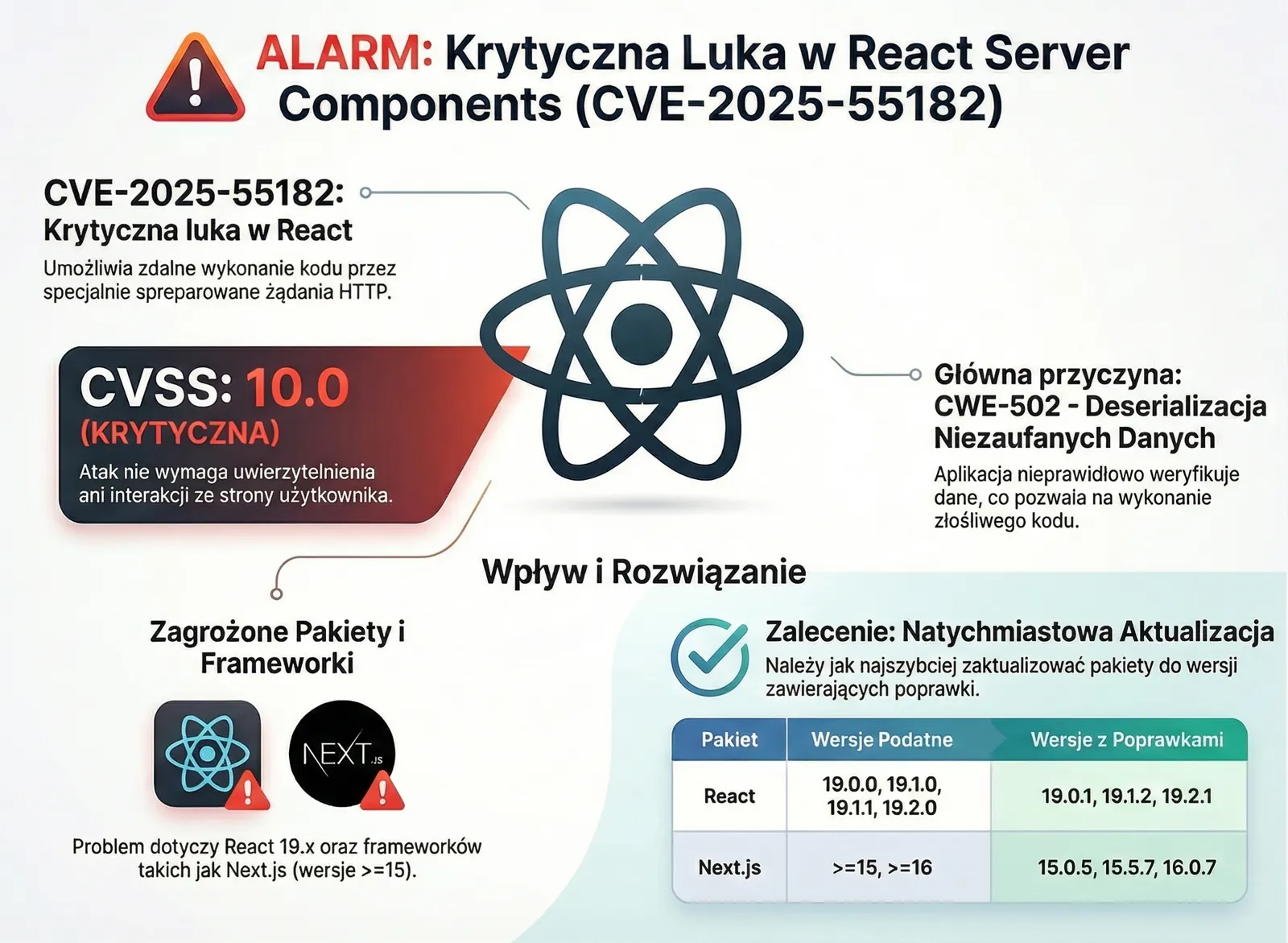
It all started with good intentions. Cloudflare was rolling out mitigations for a critical vulnerability in React Server Components (CVE-2025-55182), which we covered in detail in our article on React2Shell. To reliably detect malicious payloads targeting this flaw, its engineers had to increase the content inspection buffer in their Web Application Firewall (WAF) from the default 128KB to 1MB, which matches the limit used by Next.js.

The buffer size change was being rolled out as a gradual deployment. During the rollout, however, the team noticed that an internal WAF testing tool could not handle the larger buffer. Because the tool played no role in serving customer traffic, they decided to turn it off.
That decision set off the outage. The testing tool was switched off through the global configuration system, which pushes changes to the entire server fleet instantly. Code changes, by contrast, are rolled out slowly and in stages.
The change reached servers still running the older version of Cloudflare's proxy (FL1), which is built on NGINX and Lua. Disabling the test rule with a "killswitch" action caused the rules engine to skip a section of code, but logic further down still tried to use that section's results.
The result was a textbook error:
[lua] ... attempt to index field 'execute' (a nil value)
Put simply, the code expected a rule_result.execute object that did not exist, because the rule had been "killed" before it ran. This unhandled access on a nil (null) value produced a wave of 500 errors for every customer using Managed Rulesets on the FL1 proxy.
Cloudflare quickly identified the problem and rolled back the change at 09:12 UTC, restoring full network service.
Notably, Cloudflare's newer proxy (FL2), written in Rust, was not affected by the bug at all. Rust's strong type system made this kind of error impossible at compile time. The company has announced it will speed up its migration to Rust and introduce "fail-open" mechanisms. With fail-open, a configuration error lets traffic through (possibly without scanning) instead of blocking it entirely.
The irony is hard to miss. An attempt to defend against one vulnerability, in React, caused a global outage through a bug that had gone unnoticed in the code for years.
Aleksander
Read more
On November 18, 2025, a Cloudflare outage took down X, ChatGPT and Zoom just a month after AWS. Here's what happened and why it matters.
A critical flaw in React Server Components (CVE-2025-55182) enables unauthenticated remote code execution and scored a maximum CVSS 10.0. Patch now.
On November 18, 2025, Cloudflare went dark for hours. It wasn't a DDoS attack but a database permissions change. Here's the full technical breakdown.
A free consultation with one of our experts — no obligation, in full confidence.
Let's talkWe'd like to use Google Analytics cookies to see how many people visit the site and which content is useful. We'll only set them if you agree. You can change your decision at any time via the “Cookie settings” link in the footer. Cookies Policy