
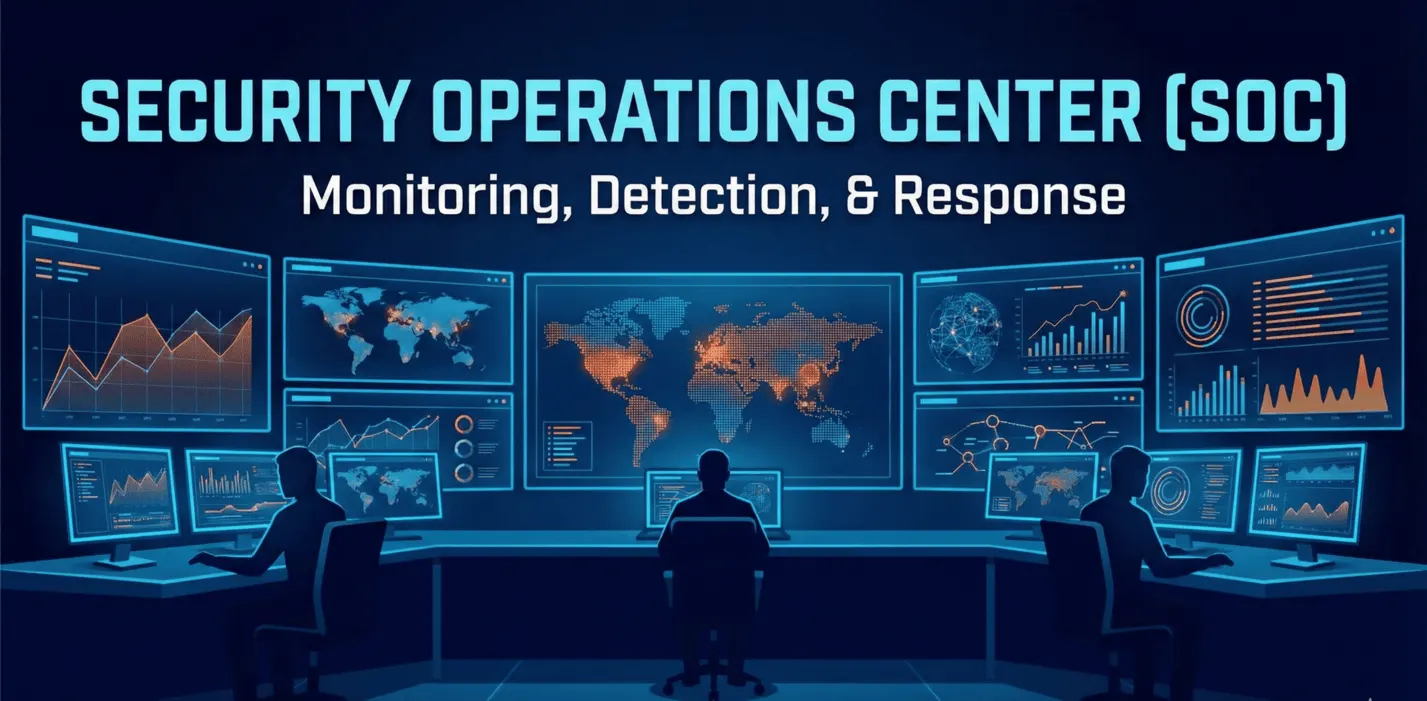
Security Operations Center (SOC): The Complete 2026 Guide to Building and Implementing a SOC
Your 2026 guide to the Security Operations Center: team structure, SIEM/XDR/SOAR, NIS2 requirements, deployment models and AI. For CISOs and IT leaders.
Cybersecurity
SOC analysts are drowning in false alarms. Here's how SOAR playbooks and agentic AI cut response times from hours to seconds and help end alert fatigue.

Imagine a job where your "boss," in this case a computer system, yells at you several thousand times a day. Most of that yelling is a false alarm. Someone forgot their password. Someone else ran a port scanner while testing a new app. But you still have to check every single one. Sounds like a recipe for burnout? Welcome to the world of the Security Operations Center (SOC) analyst.
Modern cybersecurity architecture has reached a breaking point. The "digital explosion" and the move to the cloud have pushed alert volumes beyond what the human brain can handle. But help is coming, and it isn't another cup of coffee. It's a fundamental shift in approach: SOAR (Security Orchestration, Automation, and Response) and the coming Agentic AI revolution.
Here's what you need to know about how automation is changing the game in 2025.
Let's start with a number that should alarm every CFO. SOC analysts spend an average of 32 minutes checking a single false alert. The industry even has a name for it: "chasing ghosts."
This constant overload leads to alert fatigue. Our brains simply shut down. That isn't laziness; it's biology. The result? Staff become desensitized, and there's a real risk that the one genuine breach gets lost in the noise. SOAR isn't a shiny toy for gadget lovers. It's how you stop wasting your people's brainpower on mechanical work that a script can do in milliseconds.
People often mix up these two terms. Think of the human body. SIEM (Security Information and Event Management) is the brain of detection. It collects signals from the eyes and ears, analyzes them, and says, "Hey, that's hot!" SOAR is the muscular and nervous system. It pulls your hand back automatically, before you've even had time to think "ouch."
Orchestration works as an abstraction layer that "translates" alerts from one system into actions in another.
That means an analyst no longer has to log in to 50 different consoles and copy and paste data between them. Instead, they get a "Single Pane of Glass": one screen that shows the full context without the extra noise.
Playbooks, or response scenarios, are the heart of SOAR. This is where the ROI happens. Take phishing as an example.
In the "old world," an analyst gets a report, checks the email headers, submits the URL to VirusTotal, waits for the result, then hunts down everyone else who got the same email and asks the mail server admin to delete it... That takes 45 minutes. With SOAR? A playbook does all of this automatically. If it finds a threat, it runs a "Search and Purge," hard-deleting the malicious message from the inbox of every employee in the organization. Time to complete: under 60 seconds.
It's even more impressive with ransomware, where every minute means thousands of encrypted files. SOAR doesn't wait for a human. If EDR detects an encryption process, the automation immediately cuts the host off from the network, leaving only a tunnel open for the administrator. Relentless, machine-speed response.
If traditional playbooks are a GPS that follows a fixed route (and gets lost when a road is closed), then Agentic AI (autonomous AI agents) is like a smart driver who knows the city like the back of their hand.
We're entering an era where rigid "If-This-Then-That" logic is no longer enough. The next generation of automation, expected in 2025, is driven by goals rather than scripts. An AI agent gets a task like "Investigate this process." It decides for itself what data to collect, which hypotheses to form, and how to test them. It can adapt.
Traditional SOAR works like a GPS system following a strictly defined route: if the road is closed, the system may not know how to find a detour. Agentic AI works like an autonomous, intelligent driver.
Rolling out full automation isn't just a technical challenge (the so-called API integration hell). Above all, it's a cultural one. There's a legitimate fear that the automation will make the wrong call and, for example, cut the CEO off from the network or stop a production line.
That's why, despite the AI revolution, the human-in-the-loop model is still going strong. The automation prepares the "case file" and gathers the evidence, but a human presses the final "Isolate" button. Building trust in the machine takes time.
Don't worry that SOAR will take our jobs. It's true that the alert "screener" role will disappear. In its place, though, comes the role of the Threat Hunter: a strategist who, instead of fighting a flood of logs, actively hunts for threats too subtle for automation to catch.
In 2025, automation stops being a tech novelty and becomes a strategic foundation. In a world of machine-driven threats, we have to defend ourselves at machine speed.
Aleksander
Thinking about automating security operations in your organization? Want to reduce alert fatigue and unlock your SOC team's full potential? Contact us. We'll help you choose the right SOAR platform and design playbooks tailored to your infrastructure.
#SOAR #SecurityOrchestration #Automation #SOC #Cybersecurity #InfoSec #AlertFatigue #Playbooks #IncidentResponse #AgenticAI #SIEM #XDR #EDR #ThreatHunting #Ransomware #Phishing #NIS2 #ManagedSOC #MSSP #SecOps
SOAR (Security Orchestration, Automation, and Response) is a platform that combines security tool orchestration, automation of repetitive tasks, and smart incident response management. SOAR lets SOC analysts focus on strategic thinking instead of mechanical "console clicking."
SIEM (Security Information and Event Management) is the "brain of detection": it collects and analyzes logs, detects anomalies, and generates alerts. SOAR is the "muscular system": it responds to alerts automatically, orchestrates actions across different systems, and runs playbooks. SIEM says "that's hot"; SOAR takes action immediately.
Playbooks are automated response scenarios for security incidents. They define, step by step, what the system should do in response to a specific type of threat (such as phishing, ransomware, or DDoS). With playbooks, tasks that used to take an analyst 45 minutes can be completed automatically in under 60 seconds.
Alert fatigue happens when analysts bombarded with thousands of false alarms a day lose focus and start ignoring them. SOAR solves this by automatically triaging alerts, filtering out false positives, and handling routine actions without human intervention, so analysts can focus on real threats.
With ransomware, every minute means thousands of encrypted files. SOAR can respond in under 60 seconds: when EDR detects an encryption process, a playbook automatically isolates the host from the network (leaving a tunnel open for the admin), blocks related accounts, and alerts the team. Without SOAR, the same steps could take 15–30 minutes.
Traditional SOAR works like a GPS: it follows a fixed route based on "If-This-Then-That" rules. If the situation strays from the script, the system can get lost. Agentic AI is an autonomous, intelligent agent that is given a goal (e.g., "Investigate this process") and decides for itself what steps to take, adapting as the situation changes. It's the evolution from rigid scripts to smart, context-aware action.
No. SOAR eliminates the alert "screener" role, the monotonous work that drives burnout. In its place comes the role of the Threat Hunter: a strategist who actively hunts for threats too subtle for automation. SOAR takes robotic work off people's plates so they can focus on tasks that call for creativity and strategic thinking.
Phishing: Automatically analyzing a suspicious email, checking the URL in VirusTotal, finding every user who received the message, and deleting it from all inboxes (Search and Purge), all in <60 seconds.
Ransomware: Immediately isolating the infected host, blocking related accounts, and notifying the team, in real time.
Brute-force: Detecting attacks on accounts, automatically blocking the IP address, and forcing password resets on compromised accounts.
Human-in-the-loop is a model where the automation prepares the "case file," gathers evidence, and recommends an action, but a human makes the final decision. This approach is used in critical situations where a wrong automated decision could have serious consequences (for example, locking the CEO out). Building trust in automation takes time.
SOAR costs vary with the size of the organization and the platform you choose. Licenses can run from USD 50,000 to USD 500,000 per year. However, the ROI comes quickly: by automating routine tasks, a single analyst can do work that used to take 3–5 people. On top of that, cutting response times from hours to minutes can prevent incidents that cost millions.
The most popular SOAR platforms include:
Even small companies can benefit from SOAR, especially given NIS2 requirements, which mandate rapid incident response. For smaller organizations, good options include lighter platforms (such as Tines or Shuffle) or Managed SOC with SOAR, a subscription model in which an external provider (MSSP) supplies both the platform and the experts.
Read more
Your 2026 guide to the Security Operations Center: team structure, SIEM/XDR/SOAR, NIS2 requirements, deployment models and AI. For CISOs and IT leaders.
It's not if but when. Build an NIS2-ready incident response plan: 24/72h reporting, CSIRT roles, ransomware playbooks and tabletop exercises.
Agentic AI is rewriting the threat landscape. Learn how Claude Code was weaponized by APT groups like GTG-1002 and why Vibe Hacking matters.
A free consultation with one of our experts — no obligation, in full confidence.
Let's talkWe'd like to use Google Analytics cookies to see how many people visit the site and which content is useful. We'll only set them if you agree. You can change your decision at any time via the “Cookie settings” link in the footer. Cookies Policy