Cyberattacks Up 48% in September 2026, Europe Up 61%: Check Point Report
Check Point: cyberattacks rose 48% year over year in September 2026 and 61% in Europe, with ransomware up 53%. Key takeaways for businesses.
Analysis
Tesla's Mixed-Precision Bridge patent application brings 32-bit AI precision to cheap 8-bit chips. What it means for FSD, Optimus and edge AI.
Computing power is becoming the currency of the future, and Tesla has just made a move that could change the game. The company has filed a patent application for a "mathematical trick" that lets cheap 8-bit chips perform with the efficiency and precision of expensive 32-bit processors. The approach is described in patent application US20260017019A1 and could be the key to mass adoption of autonomous vehicles and humanoid robots. Strictly speaking, this is a patent application, not a granted patent. However, Tesla gets about 89% of its patent applications approved, so the odds that this one will be granted are very high.
How can a car remember a stop sign it hasn't seen for 30 seconds? How can a humanoid robot keep perfect balance while carrying a heavy, shifting load?
The answer is Rotary Positional Encoding (RoPE), a kind of "GPS for the mind" that lets AI understand where it is in time and space by assigning a unique rotation angle to every piece of data.
Normally, this math is brutal on hardware. Keeping those angles from "drifting" into chaos takes power-hungry, hot-running 32-bit processors, which are chips that calculate with extreme decimal precision.
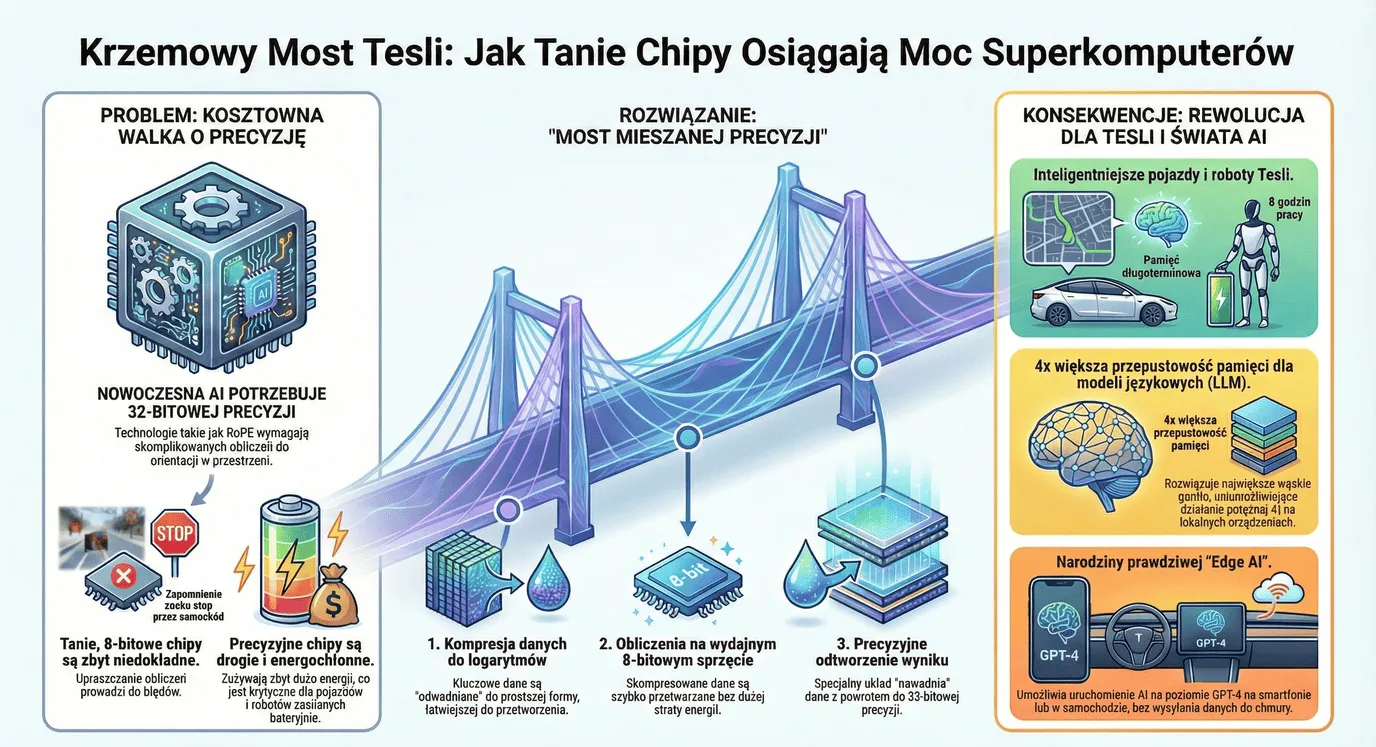
Tesla has found a way around this physical limit. Its newly disclosed "MIXED-PRECISION BRIDGE" is a mathematical translator. It lets affordable, low-power 8-bit hardware, which can usually handle only simple, rounded numbers, perform complex 32-bit rotations without losing a single coordinate.
The breakthrough works as a "silicon bridge." It gives Optimus and FSD (Full Self-Driving) top-tier intelligence without cutting range or melting the internal circuitry. In effect, it turns Tesla's efficient, "budget" hardware into a high-fidelity supercomputer on wheels.
Self-driving cars and humanoid robots face a constant trade-off between precision and power. Modern AI models such as Transformers rely on RoPE to understand where objects sit in a sequence or in 3D space.
The catch is that these trigonometric functions (sines and cosines) usually require 32-bit floating-point math. Think of calculating a flight path to 10 decimal places.
If you try to squeeze that math into the standard 8-bit (INT8) multipliers used for speed, which is like rounding everything to the nearest whole number, errors pile up quickly. In effect, the car goes blind to fine detail.
For a robot like Optimus, a small math error can mean losing its balance or misjudging the distance to a fragile object. To close this gap without adding expensive chips, Tesla had to rethink from the ground up how data moves through the silicon.
Tesla's engineers realized they didn't need high precision across the entire pipeline. Instead, they designed the "Mixed-Precision Bridge."
They take the key angles used for positioning and convert them into logarithms. A logarithm has a much smaller "dynamic range" than the original number, so the data can pass through narrow 8-bit hardware far more easily without losing the "soul" of the information.
It's a bit like dehydrating food for shipping: it takes up less space and is easier to handle, and you can restore it perfectly later.
Importantly, the patent shows that the system doesn't calculate these logarithms on the fly every time. It pulls precomputed logarithmic values from a special "cheat sheet" (lookup memory) to save processor cycles.
When the 8-bit multiplier (multiplier-accumulator, or MAC) finishes its work, the data is still in its "dehydrated" logarithmic form. To turn it back into the actual angle theta without a huge computational cost, Tesla's high-precision ALU uses a Taylor series expansion optimized with Horner's method.
This is a classic computer science trick that breaks a complex equation (such as an exponential) into a simple chain of multiplications and additions.
The calculation runs in three specific stages, multiplying by constants such as 1/3 and 1/2 at each step. This lets Tesla approximate the exact angle with 32-bit precision while using only a fraction of the clock cycles.
Once the algorithm has recovered the angle, the high-precision logic generates a rotation matrix (a grid of sine and cosine values) that locks the data points into their correct 3D coordinates.
That computational efficiency is impressive, but Tesla didn't stop at faster math. It also found a way to double the "highway speed" of the data itself.
One of the cleverest hardware "hacks" in the patent is how Tesla sends 16-bit precision over an 8-bit bus. It uses the MAC as a high-speed interleaver, essentially a "traffic cop" that merges two lanes of data.
It takes two 8-bit values (say, an X coordinate and the first half of a logarithm) and multiplies one of them by a power of two to "left-shift" it by several bits.
This effectively joins them into a single 16-bit word in the output register. The low-precision domain acts as a fast packer, and the high-precision ALU "unpacks" the result.
The trick effectively doubles the throughput of the chip's existing wiring without any physical hardware redesign. With this fast data highway in place, the system can finally take on one of the biggest challenges in autonomous AI: object permanence.
The ultimate goal of this high-precision math is to solve the problem of "forgetting." In earlier versions of FSD, the car could see a stop sign, but if a truck blocked it for 5 seconds, the car might "forget" the sign was there.
Tesla uses a "long-context" window that lets the AI look back at data from 30 seconds ago or more.
However, standard positional math tends to drift as the "distance" in time grows. Tesla's mixed-precision pipeline fixes this by maintaining high positional resolution, so the AI knows exactly where that hidden stop sign is, even after a long stretch of driving.
The RoPE rotations are so precise that the sign stays "pinned" to its 3D coordinate on the car's mental map. But remembering 30 seconds of high-fidelity video creates a huge memory bottleneck.
To make these 30-second memories usable in real time without running out of RAM, Tesla optimizes the KV cache (key-value cache), which serves as the AI's working-memory "scratchpad."
Tesla's hardware handles this by storing the position logarithms directly in the cache. This cuts memory requirements by 50% or more, so Tesla can keep twice as much "history" (up to 128k tokens) in the same amount of RAM.
Tesla also uses Paged Attention, a trick borrowed from operating systems. Instead of reserving one massive, contiguous block of memory, which wastes space, it splits memory into small "pages."
This lets the AI5 chip allocate space dynamically, only where it's needed. As a result, the car can track far more objects at once (pedestrians, cars, signs) without the system lagging.
One subtle but critical detail in the patent is how Tesla protects this data. Once the transformed coordinates are generated, they are stored in a specific location that downstream components can read from but not write to.
The high-precision ALU itself can't read from that location either.
This one-way "airlock" keeps the system from accidentally overwriting its own past memories or creating feedback loops that could make the AI hallucinate. The "truth" about the car's position flows in only one direction: forward, toward the decision engine.
Even with a slimmed-down KV cache, a robot running for hours can't remember everything forever. Tesla handles this with attention sink tokens.
Transformers tend to dump "excess" attention math onto the very first tokens in a sequence. If Tesla simply used a "sliding window" that deleted old memories, the AI would lose these "sink" tokens and its brain would effectively crash.
Tesla's hardware is designed to "pin" these attention sinks permanently in the KV cache. Because these mathematical anchors stay fixed while the rest of the memory window slides forward, the robot's neural network stays stable through long, multi-hour work shifts.
The new architecture also uses Native Sparse Acceleration for sparse tensors. In the real world, most of what a robot sees is "empty space." Tesla's chip stores only the non-zero values and skips the "dead space," which doubles throughput and cuts power consumption significantly.
This approach reaches far beyond autonomous vehicles and robotics. RoPE (Rotary Positional Encoding) is now a foundation of today's most advanced large language models (LLMs), including the Llama, Mistral and Qwen families.
The main bottleneck in running powerful models (for example, the 70-billion-parameter class) on local devices usually isn't a lack of raw compute (FLOPS). It's memory bandwidth. These models are "data-hungry": the processor spends more time waiting for data to arrive from RAM than actually processing it.
With the Mixed-Precision Bridge and logarithmic compression, Tesla effectively quadruples the available memory bandwidth for these operations. The implications for the entire AI sector are enormous:
The patent shows that Tesla is designing its chips not just as "drivers" but as general-purpose engines for a new generation of decentralized AI.
This patent is more than a "nice-to-have." It is the mathematical prerequisite for Tesla's entire hardware roadmap. Without the Mixed-Precision Bridge, the thermal and power math for next-generation autonomy simply doesn't work.
It starts with unlocking the AI5 chip, which is expected to be 40 times more powerful than current hardware. Raw power is useless if memory bandwidth chokes it.
The stakes are even higher for Tesla Optimus, where this is a matter of operational survival. The robot runs on a 2.3 kWh battery. Standard 32-bit GPU computing would drain it in under 4 hours. With hybrid logic, Tesla brings the compute power budget below 100 W, enough for a full 8-hour shift.
Finally, "burning" this math into silicon makes Tesla strategically independent of NVIDIA's CUDA ecosystem and enables a dual-foundry strategy (with Samsung and TSMC). It also opens the door to running world-class vision models on hardware as small as a smart home hub or a smartphone, bringing supercomputer-level intelligence to end devices without sending private data to the cloud.
Aleksander
No. The Mixed-Precision Bridge is a hardware solution, not a software one. It requires dedicated logic circuits built physically into the chip. It will most likely debut with the next-generation computer, AI5 (HW5).
It comes down to power and heat. 32-bit chips draw much more power and generate more heat. In an electric car, that affects range. In a battery-powered robot like Optimus, every watt counts even more. This approach delivers 32-bit quality at the power "price" of 8-bit.
Definitely not. FSD infrastructure is the main beneficiary, but the patent clearly points to applications in robotics (Optimus) and edge AI more broadly. It would make it possible to run advanced large language models (LLMs) on small home devices without a cloud connection.
Formally, it is still a patent application. However, given how innovative the approach is and Tesla's track record, final approval is very likely.
RoPE (Rotary Positional Encoding) is a mathematical method that helps AI models understand "where" data is located (for example, words in a sentence or objects on the road) by rotating its representation in space. It is key to maintaining context and "memory" in modern neural networks.
It is Tesla's hardware architecture that lets cheap, low-power 8-bit chips perform complex calculations with the precision you would normally expect from expensive 32-bit chips. It does this through logarithmic compression and precomputation.
The patent doesn't directly affect market prices for RAM, but it does make the system "cheaper" to build. Because memory is used more efficiently (compression of 50% or more), Tesla can use fewer RAM chips to get the same result, which lowers the production cost of the whole AI computer.
Read more
Check Point: cyberattacks rose 48% year over year in September 2026 and 61% in Europe, with ransomware up 53%. Key takeaways for businesses.
Can AI have trauma? Researchers put ChatGPT, Gemini and Grok through therapy sessions. The result: synthetic psychopathology and a new jailbreak risk.
Everyone's feeling the vibe, but nobody reads the code. We look at vibe coding, the rise of slopsquatting, and how AI quietly weakens app security.
A free consultation with one of our experts — no obligation, in full confidence.
Let's talkWe'd like to use Google Analytics cookies to see how many people visit the site and which content is useful. We'll only set them if you agree. You can change your decision at any time via the “Cookie settings” link in the footer. Cookies Policy